Adrianne Marsh: Uncovering rural voters' fears about AI through qualitative research


Why did Altum Insight look to the midwest for their latest study uncovering voters' deeply held reservations about AI? According to Altum CEO Adrianne Marsh, “There’s just enough going on in Nebraska where we were able to get the kind of sample we were looking for."
Marsh recently joined hosts Dr. Mark George Bound, Dr. Scott Gerschwer, and Dr. Brooklynn Ann Welden of The Nova Society about Altum Insight's groundbreaking study on rural Nebraska voters and why it's time for Democrats to broaden their understanding of what qualitative research can offer.
Specifically, she says, a deeper look at voter behavior could be the missing ingredient to help address the sinking Democratic brand in places where party-aligned candidates continue to struggle.
"One of the interesting things about Nebraska or Oklahoma, or Indiana, or my beloved Missouri, These places have ballot initiatives where they perform at levels of 55, 60, 70 percent on progressive issues. We’re talking Medicaid expansion, we’re talking minimum wage, we’re talking about choice issues. They’re performing very very well.
But these same states, Jesus H. Christ himself could run and put a D behind his name and he can’t get elected dog catcher. It’s ridiculous that the brand is so heavy in some of these places. It’s not our agenda that they’re upset with. it’s our brand. It’s the way we’re talking to people.
So we’re trying to go into places where that brand rejection is firm, the vacuum is there… We wanted to go in and find out what is going on.”
Altum Insight specializes in a hybrid approach that combines digital ethnography with narrative analysis. Marsh says, "It allows us to understand the stories that people are telling themselves about the world around them…and we not only get to have a realistic idea of where we are in that story, but we learn enough about how we got there that we can understand what to do about it."
"Polling is important, focus groups are important, ad testing is important, but it’s almost too far down the line, we’re starting too far in."
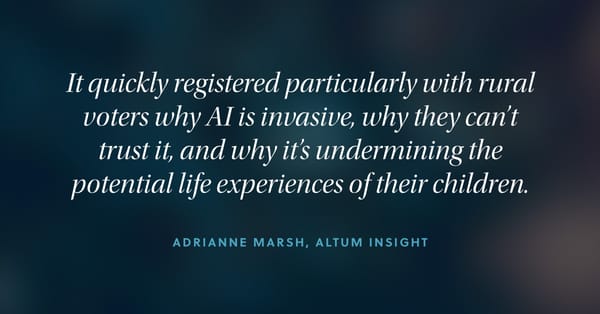
According to Marsh, the findings of the Nebraska study were surprising – not only in pointing to voters' strong reservations about AI, but even moreso in identifying the underlying reasons for it:
"What we’ve found in that rural study is that there are real fears about the values pieces of AI that are undermining small town values or undermining that special way of life, and moreso than anything, they are undermining the future that they dream of for their kids – one that’s now clouded, and maybe unbelievable, and it’s compromised.
And it looks like Republicans are in bed with tech and with AI, and this could be an opening for Democrats because we do have credibility around consumer protection...We can now have a values conversation that we’ve been shut out of for the last decade.”
While recent polling has supported the finding that voters do not trust AI – nor do they trust politicians to navigate or protect them from its effects – Marsh argues a conventional poll may never have uncovered the reasons behind those fears. That, she says, is where innovative research methods that began in larger industries can help Democrats understand the deeper narratives at work, in order to build campaigns – and a party brand – that resonate. It could mean the difference between winning and losing in places were Democrats used to be more competitive.
It's not a matter of not having the resources to think more broadly. As Marsh points out, "Last cycle we spent $12 billion between the two parties – that rivals industry spending along pharmaceutical lines. Along automotive lines. These are big, big ad spenders. We’ve got gobs of money. We are a full, legitimate industry and we’re still starting with polling when this kind of research has been standard practice in those same industrial places for 20 years."
Marsh believes there will always be a need for polling, but that it should be informed by – and informing – a process of research that also includes qualitative tools. "It’s not that we don’t need polling. Those same industrial efforts are still polling. The problem is we’re looking at polling to [uncover narratives] too, and it doesn’t," she added.
"[Polling] takes a snapshot in time of how people believe about issues, their perceptions of language, but it’s canned and it’s boxed. What happens right now is a handful or a group of consultants – who may have tons of experience – sit in a room in Washington D.C. or somewhere else, and they say alright let’s poll this congressional district’s independent voters as a bucket...
But the idea is we’re all going to sit down and say, what should we include? Ok we’re going to include the economy, immigration, healthcare, you know, name the typical battery that goes into the issues. We’re going to test this guy because we think his name recognition is big, and how it compares to the job performance on this guy.
We’re all just guessing what should go into this instrument, and then we’re going to put it out there. But let’s say out of the ten issues you put on that list, it was the 15th that you didn’t put on there that was values components of AI and you didn’t know that. Well then we’re missing it."
In her time on the 2004 Kerry campaign, Marsh said the communications team would listen in to the nightly reports from field organizers to give them a different perspective on what was working with voters at the doors. It was there that she first learned about the swift boat ads undermining Kerry’s military service record. By the time the polls picked it up, the damage of the anti-Kerry narrative was already setting in. “What if we had been listening to the voters?”
“Polling is useful to a degree, but it cannot be doing all the research things at the same time.”
Altum Insight uses a pioneering combination of digital ethnography, AI-moderated interviews, and other tools to help Democrats go behind the scenes to identify new and emerging narratives – the “unknown unknowns” that are often driving behavior – to help inform and sharpen the other research instruments that campaign plans depend on. This method, demonstrated in the Nebraska study, shows how qualitative research can help campaigns get a more complete picture of the voting environment.
Watch the episode on Youtube:
Listen on Spotify:
Listen on Apple podcasts: